.png)
Biological Age vs Chronological Age: Why Only One Is on Your License.

Most of us have one number in our heads when someone asks how old we are. It's the one on the driver's license. Printed on birthday candles. Tracked on every medical form.
But there's a second number — one nobody mentions at your annual physical, that doesn't get printed on cards, and that turns out to matter just as much for how you feel and function day to day.
It's your biological age. And unlike your chronological age, it's something you can actually move.
What Is Biological Age — and Why Does It Differ From Your Chronological Age?
Chronological age is simply how many years you've been alive. It goes up by one every birthday and doesn't negotiate.
Biological age is how old your body actually is at the cellular level — based on how well your tissues, organs, and systems are functioning. Two people can be exactly the same chronological age and have biological ages that differ by a decade or more. We've all seen this in real life: the person who looks and moves like someone ten years younger, and the one who seems ten years older than their license says.
A lot of what determines the gap comes down to structures inside your cells called telomeres.
The Telomere Connection
Telomeres are protective caps at the ends of your chromosomes — think of them like the plastic tips on shoelaces that keep the lace from fraying. Every time your cells divide, those caps get a little shorter. When they get too short, the cell can no longer divide properly. That's cellular aging at its most basic.
How fast your telomeres shorten is not entirely fixed. Your lifestyle shapes the pace.
Research published in Biology (MDPI, 2024) found that adults who engaged in regular resistance training had telomere lengths that appeared nearly 4 years younger than those of sedentary adults of the same age. Not a 90-day challenge. Not an extreme protocol. Consistent strength training — roughly 90 minutes a week.
That's three 30-minute sessions. Or two 20-minute sessions during the week and one weekend morning before the household wakes up.
What Accelerates Biological Aging
The same research that points to exercise as protective also identifies what speeds things up in the wrong direction:
Chronic stress without real recovery — the kind most parents of young children know intimately
Poor or short sleep
A diet heavy in ultra-processed food
Sedentary days, even when you're busy (constant low-level movement isn't the same as structured exercise)
Excess alcohol
None of this is meant to pile on. The point is the opposite: small, consistent inputs compound over time. The same way habits in the wrong direction stack up, the right ones do too.
What You Can Actually Do About It
Move intentionally, not just actively. Walking, chasing your kids, and standing at school pickup count for something — but they don't replace structured strength training. Even two short sessions a week create measurable protective effects at the cellular level.
Watch your sleep. Before optimizing it, just observe it. What time are you actually getting to bed? What happens the hour before? What does morning feel like? Track it for three nights — patterns surface fast.
Feed the body you want at 70. Not a perfect diet. Enough protein, enough vegetables, enough fiber — and not letting ultra-processed food become the default because it's faster. If label-reading feels like a whole project, my Grocery Store Survival Guide walks through it in four steps.
Build recovery into your week. You can't remove the chaos of parenting young kids. But five minutes of stillness, a short walk without the phone, or one real breathing reset per day builds a cumulative buffer your biology notices.
The Bigger Picture
This isn't about chasing a past version of yourself or trying to look younger.
It's about the Tuesday ten years from now when you get on the floor with your grandkids without thinking twice.
The hike you say yes to instead of sitting out. The decade you feel like yourself in, not just survive.
Your biological age isn't fixed. That's the whole point.
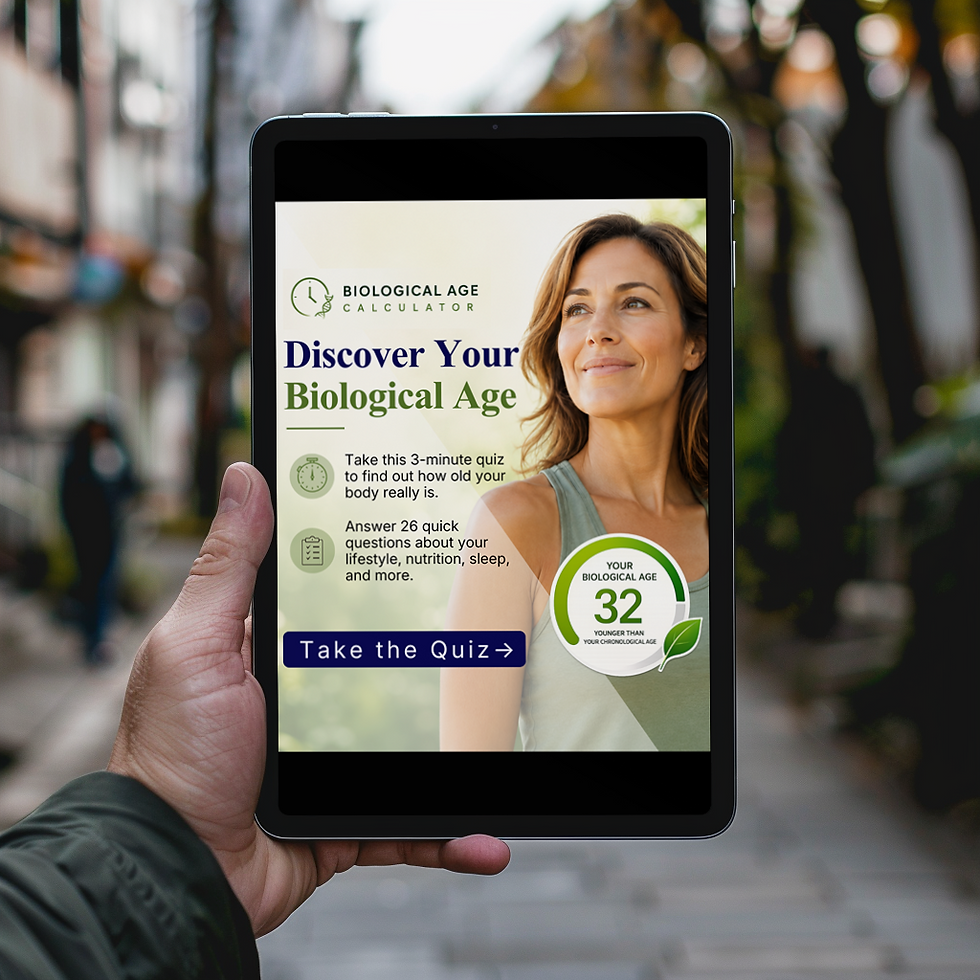
I built a Biological Clock Calculator — a practical tool to help you see where your biological age actually stands and which inputs are moving it in the right direction. It takes a couple of minutes, and you'll walk away knowing exactly which levers matter most for you. Try it now at healthylivingbymargreta.com/biological-clock-calculator. |
Sources:
Tucker, L. A., & Bates, C. J. (2024). Telomere Length and Biological Aging: The Role of Strength Training in 4814 US Men and Women. Biology, 13(11), 883. https://doi.org/10.3390/biology13110883
Cleveland Clinic. (2022). Signs of premature aging. https://my.clevelandclinic.org/health/symptoms/23105-premature-aging
Comments